EN

2x2 vs 4x4 MIMO Antennas for Indoor 5G Networks
Choosing a 2x2 MIMO antenna or a 4x4 model for indoor 5G is not simply a matter of buying the antenna with more ports. In a distributed antenna system (DAS), the useful result depends on the radio paths, feeder design, polarization, room geometry, user density, and the devices that will connect to the network. This guide gives network planners and procurement teams a practical way to compare the two options before the bill of materials is fixed.
A 2x2 MIMO antenna has two RF paths intended to support two transmit/receive streams. A 4x4 antenna provides four paths. That distinction can matter in a busy indoor venue, but it only creates value when the upstream radio and the rest of the signal chain can support the additional paths. Treat MIMO order as a system decision, not an isolated antenna specification.
Start with what 2x2 and 4x4 actually mean
For an indoor 5G deployment, a 2x2 MIMO antenna is commonly used where two well-managed RF paths meet the coverage and capacity target. It can be a sensible choice for corridors, small offices, utility areas, and other zones with moderate concurrent demand. The antenna needs appropriate polarization, usable isolation between ports, stable gain, and a pattern that suits the ceiling or wall location.
A 4x4 design adds two more RF paths. In principle, this gives the network more options for spatial multiplexing and diversity. In practice, the usable number of layers is constrained by both ends of the link, radio configuration, propagation conditions, and device capability. A 4x4 antenna is therefore not a promise of twice the user throughput. It is an infrastructure option that can help when the complete indoor system is designed to use it.
Where a 2x2 MIMO antenna is often the better fit
A 2x2 MIMO antenna is usually easier to integrate when the existing DAS or small-cell architecture already has two RF paths per service area. It can reduce feeder count, connector count, installation labor, and commissioning points compared with a four-path design. Those savings are meaningful in projects with many ceiling nodes or difficult cable routes.
- Coverage-led rooms: meeting rooms, corridors, back-of-house zones, and compact offices where coverage consistency matters more than peak sector capacity.
- Two-path radio architecture: deployments where the source equipment, remote unit, and feeder plan are designed for two paths.
- Controlled retrofit scope: upgrades where adding cable runs or remote-unit capacity would create disproportionate disruption.
- Cost discipline: projects that need a repeatable indoor node while preserving budget for survey, testing, and optimization.
Even in these cases, a 2x2 MIMO antenna should be selected by more than its port count. Confirm the required frequency bands, connector interface, gain by band, beamwidth, polarization, VSWR, port-to-port isolation, and whether a low-PIM requirement applies to the system.
When 4x4 earns its extra complexity
Four-path indoor antennas are worth evaluating in high-traffic zones such as concourses, large lobbies, enterprise collaboration floors, venues, or dense private-network areas. A 4x4 approach is most credible when the radio supports four paths, the DAS design preserves them, and the traffic model indicates a capacity need. It also needs space and routing discipline: more ports normally mean more feeder or jumper management and more opportunities for mismatch during installation.
Before upgrading a 2x2 MIMO antenna location to 4x4, ask whether the bottleneck is truly antenna-path capacity. Coverage holes caused by placement, building materials, excessive cable loss, or an unsuitable radiation pattern will not be solved merely by adding ports. A walk test, traffic profile, and link-budget review often provide a better answer than a blanket 4x4 rule.
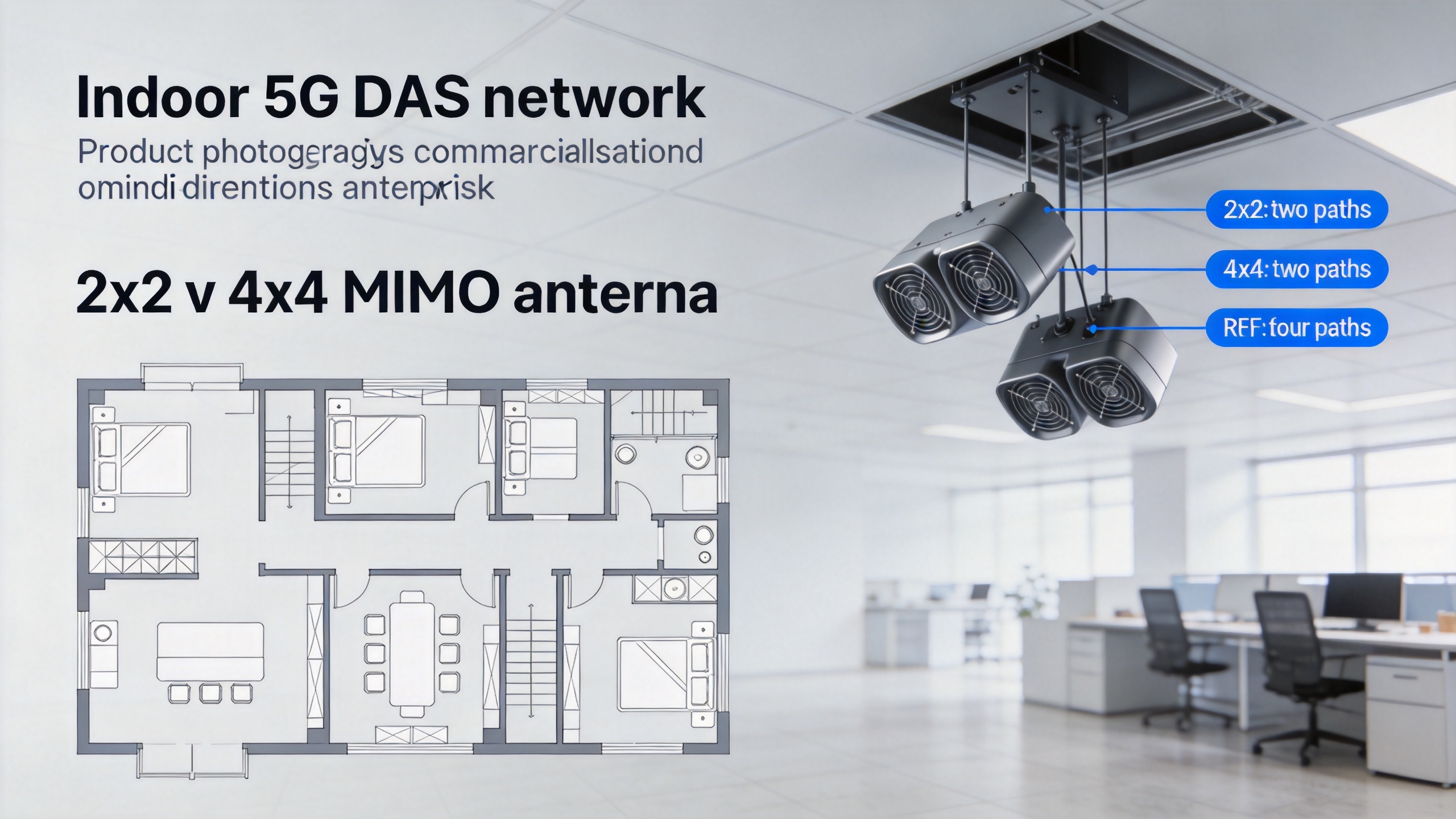
A side-by-side selection view
| Decision factor | 2x2 approach | 4x4 approach |
|---|---|---|
| RF paths | Two paths; aligns with many moderate-capacity indoor designs. | Four paths; requires compatible radio, DAS, and cabling architecture. |
| Installation scope | Fewer connections and simpler routing in typical deployments. | More ports to label, route, test, and maintain. |
| Best fit | Coverage-led or moderate-density zones. | Capacity-led zones where four usable paths are engineered end to end. |
| Key risk | Under-sizing a future high-demand area. | Paying for paths the radio, channel, or devices cannot use. |
Use this comparison as a planning screen, not as a substitute for a site survey. A 2x2 MIMO antenna with the right pattern and clean RF installation can outperform a poorly placed four-port unit in real indoor conditions.
Specifications to check before issuing a purchase order
For every 2x2 MIMO antenna or 4x4 candidate, request a datasheet that matches the intended indoor environment. The minimum review should cover operating bands, gain and pattern by band, horizontal and vertical beamwidth, polarization, isolation, VSWR, PIM requirement, connector type, mounting method, dimensions, and applicable environmental limits. The RF connector is not a minor detail: it must match the jumper and feeder plan without unnecessary adaptors.
For an example of the product information that should be verified, Zhenjiang Jiewei lists a 380-6000MHz Low PIM Indoor MIMO Omni Antenna with N-Female Connector. Its listed frequency range, low-PIM positioning, indoor use, and connector should be checked against the specific DAS and radio design; product naming alone does not establish project compatibility.
Plan the room, not just the antenna
A 2x2 MIMO antenna decision should start with a floor plan. Mark user zones, ceiling heights, partitions, reflective surfaces, cable routes, and locations where people gather at the same time. Then map the available radio paths and decide which areas need coverage resilience, which need capacity, and which can share a standard node design.
In many buildings, a mixed strategy is more practical than selecting one MIMO order everywhere. A 2x2 MIMO antenna can provide a consistent baseline across ordinary zones, while 4x4 nodes are reserved for the few areas with verified demand and compatible infrastructure. This approach keeps the DAS antenna system aligned with actual indoor coverage requirements instead of a generic specification trend.
Commissioning checks that protect the design
After installation, validate each 2x2 MIMO antenna path as part of the system, including port labeling, connector torque, continuity, return-loss or VSWR testing where applicable, and path-to-path isolation. Compare walk-test results with the coverage plan and assess busy-hour behavior rather than relying only on an empty-building test. For 4x4 areas, confirm that all four intended paths are connected and recognized through the relevant radio and DAS chain.
The same discipline applies to a 2x2 MIMO antenna retrofit. Document the original configuration, test the changed area, and retain the results so future expansion decisions are based on measured conditions. Good commissioning turns an antenna choice into an auditable engineering decision.
Make the final choice from the end-to-end design
The right choice is the option that the entire indoor 5G system can use. Select a 2x2 MIMO antenna when two paths satisfy the coverage and traffic plan and when simpler cabling improves project control. Select 4x4 when the radio, DAS, cabling, placement, and expected device mix justify four usable paths. For either route, confirm bands, polarization, isolation, low-PIM needs, connectors, and installation geometry before ordering.
By comparing the MIMO order with the actual building plan, procurement teams can avoid both under-design and unnecessary complexity. A properly specified 2x2 MIMO antenna remains a strong indoor 5G option when it is matched to the network architecture and verified at commissioning.