 EN
EN

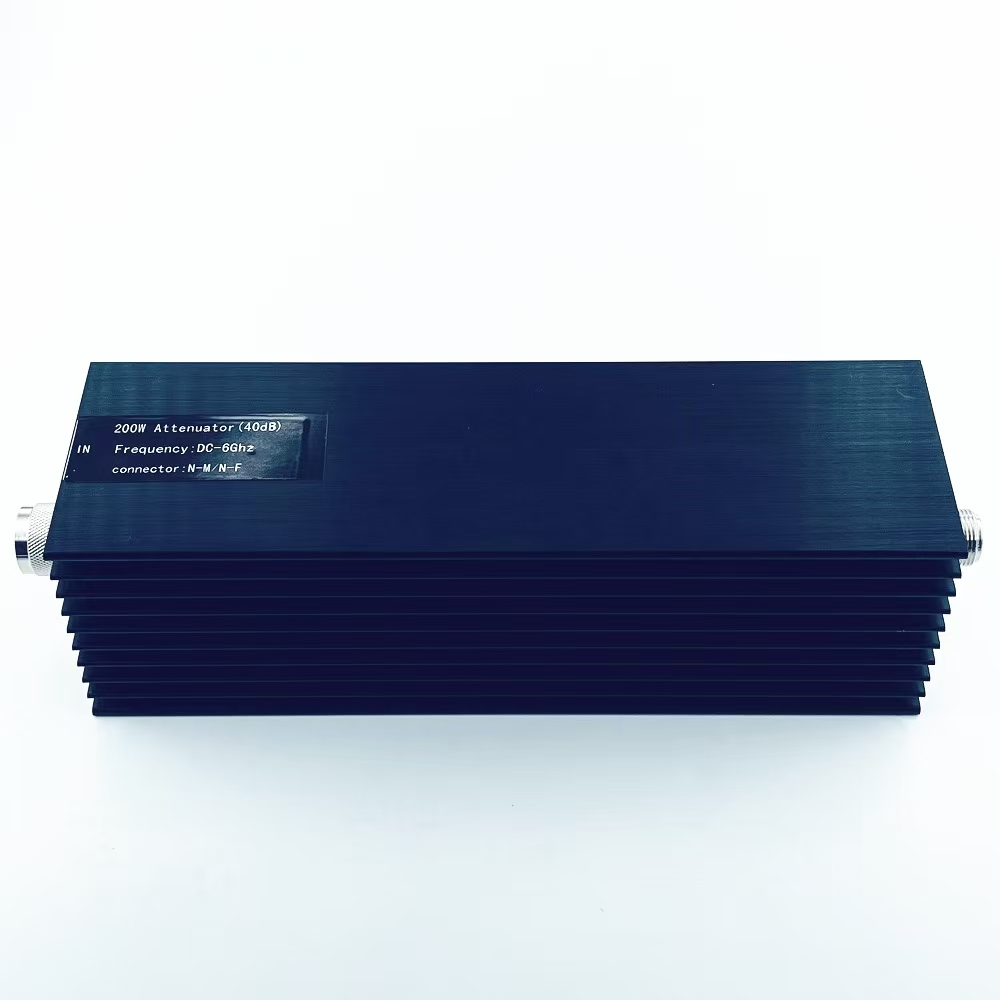
Understanding Attenuator Power Handling and Thermal Limits
What Is Power Handling Capability in Attenuators?
The power handling capability basically tells us what's the highest amount of power an attenuator can handle before it starts performing poorly or gets damaged physically. This is usually measured either in watts or dBm, and gives engineers an idea about how much energy the device can turn into heat safely. Going beyond these limits causes problems. For instance, running a 10 watt rated attenuator at 12 watts will likely destroy those internal resistors for good. Most manufacturers list two numbers: one for regular ongoing use (average power) and another for brief spikes (peak power). Military spec components tend to have ratings around 20 to 30 percent higher than their commercial counterparts since they need to last longer under harsh conditions.
How Maximum RF Input Power Level Affects Performance
When an attenuator gets hit with more RF power than it can handle, strange things start happening. The device begins acting nonlinearly, producing unwanted harmonic distortions and those pesky intermodulation products nobody wants. Look at modern 5G infrastructure for proof. A mere 10% power spike in these systems can jack up third order intercept distortion by as much as 15 decibels. And let's not forget about heat issues either. Keep pushing an attenuator beyond its limits and thermal stress builds up fast. Components just don't last as long under such conditions. Recent tests from IEEE show lifespans dropping nearly two thirds when subjected to constant overload. Audio engineers know this all too well too. Anyone running a 100 watt tube amp needs to pair it with at minimum a 150 watt rated attenuator if they want to survive those sudden loud passages without getting clipped signals.
The Role of Power Dissipation in Attenuators
To figure out power dissipation (Pdiss), we use this equation: Pdiss equals V squared multiplied by the attenuation ratio divided by Z times one minus the attenuation ratio. Here, Z stands for system impedance. Let's take a real world case: when a 50 ohm attenuator cuts down a 40 dBm signal by around 3 dB, it generates roughly 9.5 watts worth of heat. Good thermal management makes sure all that extra warmth gets carried away properly through heatsinks or just into the surrounding air, so hotspots don't build up anywhere on the circuit board.
| Attenuator Type | Typical Power Rating | Thermal Resistance |
|---|---|---|
| Fixed Chip | 1–5W | 35°C/W |
| Variable Waveguide | 10–200W | 12°C/W |
Thermal Management and Material Considerations
For high power attenuators above 10 watts, manufacturers turn to better materials such as aluminum nitride substrates that conduct heat at around 170 to 180 W per meter Kelvin. These beat old school FR4 materials (which only manage about 0.3 W/mK) by a huge margin. A recent look at the market for coaxial attenuators shows something interesting too. When we get into those really powerful units over 50 watts, most need some kind of active cooling system in about three quarters of aerospace setups. Temperature changes matter quite a bit as well. If the ambient temp goes up by 10 degrees Celsius, air cooled systems lose roughly 8 percent of their power handling capability. That means engineers have to adjust ratings downward when working in hot environments, making sure components don't overheat and fail unexpectedly.
Industry Standards for Power Ratings in Fixed and Variable Attenuators
Military grade attenuators must handle surges twice their normal capacity according to MIL-STD-348A specifications. Commercial versions aren't held to quite such strict standards under IEC 60169-16, needing only to survive 150% peak power for one millisecond. When it comes to variable attenuators though, there's another layer of durability testing required. The IEC 60601-2-1 standard demands they operate through half a million cycles without significant degradation, specifically keeping insertion loss below 0.15dB even when running at full power capacity. All these rigorous tests are necessary because equipment needs to function reliably in temperatures ranging from minus 55 degrees Celsius all the way up to plus 125 degrees. This matters a lot for industries like defense systems where failure isn't an option, as well as aerospace operations and telecom networks that rely on consistent signal transmission regardless of environmental conditions.
Matching Attenuator Power to RF, Microwave, and Audio Applications
Evaluating Signal Levels in RF and Microwave Systems
Getting the power levels right matters a lot when working with RF and microwave systems these days. Take base stations dealing with those 10 watt continuous signals - most engineers will go for attenuators rated at least 15 watts to keep things from overheating, according to what's been standard practice since 2023. Then there's radar systems where the pulses can hit over 1000 watts at their peak, so the attenuators need to handle that kind of surge without failing. Satellite receivers tell a different story though, they usually need components good for under a single watt to safeguard those delicate low noise amplifiers inside. We've actually seen some pretty costly problems happen when people get this wrong. One study from Ponemon back in 2023 showed that mismatched attenuation in 5G mmWave arrays cost companies around $740,000 worth of damaged equipment. That kind of money talks about how critical proper power management really is.
Use of Attenuators in Guitar Amps for Volume Control: A Practical Example
In audio engineering circles, attenuators tackle one big problem musicians face all the time getting that classic tube amp distortion without cranking up the volume to dangerous levels. According to research published last year in Audio Engineering journal, when someone connects a standard 50 watt guitar amplifier to a good quality 30 dB attenuator, the actual power going out drops down to just half a watt but the tone stays pretty much intact. What this means is speakers don't get damaged from constant high volume playback, yet those rich harmonics we love so much still come through. Blues players and rock bands especially appreciate this because their signature sounds rely heavily on sustain and controlled overdrive effects which would otherwise be impossible to achieve safely at home practice volumes.
Pulse vs. Continuous Wave: Impact on Power Selection
| Signal Type | Power Rating Basis | Key Consideration |
|---|---|---|
| Continuous Wave | Average Power | Heat dissipation capacity |
| Pulsed (Radar/Lidar) | Peak Power | Dielectric breakdown limits |
Pulsed systems generally handle about 20 percent more peak power compared to continuous wave (CW) systems according to RF Hardware Analysis from 2023. This capability allows engineers to design smaller attenuators for phased array antenna applications. On the flip side though, when CW rated components get used in pulsed environments like automotive radar systems, they tend to wear out around 40% quicker based on field data collected in 2024. The numbers really drive home why matching the right signal type to equipment matters so much in these applications.
Fixed vs. Variable Attenuators: Power Rating Trade-offs
Design and Power Limitations in Fixed Attenuators
Fixed attenuators give pretty much the same signal reduction every time they're used, which is great for consistency. But there's a catch - their solid construction means they can't handle much power before things start getting dicey. Most RF versions work fine from around 1 watt up to about 50 watts. Some big broadcast stations need something beefier though, so they go for models that can take up to 1,000 watts instead. These little boxes are usually made with thin film resistors sitting on alumina bases. They do keep temperatures stable during operation, which is good news for reliability. The downside? Heat tends to build up faster than in those newer modular systems many companies are switching to these days.
| Power Class | Range | Typical Applications |
|---|---|---|
| Low Power | Up to 1 W | Consumer electronics |
| Medium Power | 1 W to 10 W | Telecommunications |
| High Power | 10 W to 50 W | Aerospace & defense |
| Ultra High Power | Above 50 W | Broadcast transmitters |
As shown in industry reports on coaxial attenuation systems, material selection becomes critical above 20 W, where ceramic-loaded composites improve thermal conductivity by 40% over standard FR4 laminates.
Power Handling Challenges in Variable Attenuation Circuits
The problem with variable attenuators is they have moving parts or switches that just don't last as long as we'd like. When looking at models with PIN diodes or those MEMS switches, most can only handle around 15 to maybe 25 watts before things start breaking down from contact wear and unstable impedance issues. Running thermal simulations shows something interesting too - those rotary type designs tend to get about 12 percent hotter spots compared to fixed ones when subjected to the same workload. That's why smart engineers usually cut back on power ratings by roughly 30% for continuous wave applications. It helps avoid nasty surprises like arcing problems and outright thermal failures down the road.
Voltage Standing Wave Ratio (VSWR) and Its Effect on Power Capacity
A VSWR exceeding 1.5:1 reduces effective power handling by up to 11% due to reflected energy. Fixed attenuators generally maintain superior VSWR stability (<1.2:1 across 80% of models), whereas mechanical variable types exhibit higher mismatch (1.3–1.8:1). This reflection-induced heating contributes to 23% of premature failures in adjustable RF attenuators, based on field reliability data.
Impedance, Mismatch Losses, and System Compatibility
Why 50 Ohm Systems Dominate RF Attenuator Design
The 50 ohm standard became popular because it strikes a good middle ground between how much power can be handled and minimizing signal loss in coax cables, which is why most RF systems stick with this impedance level. At 50 ohms, we get pretty decent power transfer efficiency without having to deal with impractically thick conductors or exotic dielectrics. This works well across a wide frequency range too, holding up reliably even when signals reach frequencies around 18 gigahertz. For those working in RF design, almost all attenuators come rated specifically for 50 ohms. That makes things much easier when connecting different components together since everything from test gear to actual antennas just plugs right in without needing special adapters or modifications.
Mismatch Losses and Their Impact on Effective Power Dissipation
When there's an impedance mismatch, it creates these reflected power waves that actually cancel out parts of the forward signal. This causes extra heat buildup in the attenuators. For most RF systems, when we see a voltage standing wave ratio around 2:1, about 11 percent of the incoming power gets reflected back instead of being properly attenuated. What does this mean for real world operations? Well, system efficiency drops somewhere between 20 to 22 percent at higher frequencies. And over time, all that extra heat from these constant reflections wears down components faster than normal, shortening their lifespan significantly.
Case Study: Overheating Due to Impedance Mismatch in High-Power Applications
One satellite comms company kept running into trouble with their 100 watt coaxial attenuators even though they were rated for continuous operation. When engineers dug deeper, they found out the issue stemmed from a system impedance of 65 ohms working against components designed for 50 ohms. This mismatch of around 23 percent led to standing waves forming in the system. These waves basically focused all the heat right at those connector points whenever there was a sudden surge in power. Within just 300 hours of operation, materials would reach their breaking point. Things changed dramatically after the team switched over to specially made 65 ohm attenuators featuring better thermal management interfaces. Failure intervals shot up from an average of 1,200 hours to nearly 8,500 hours, making a huge difference in system reliability and maintenance costs.
Selecting the Right Attenuator: A Practical Decision Framework
Step 1: Define Maximum RF Input Power Level
Start by measuring your system’s peak power output—whether it involves continuous 100W signals or brief 1kW pulses. Select attenuators with ratings 20–30% above these levels to provide a safety margin against thermal failure, as recommended by IEC 60169-17:2023.
Step 2: Assess Environmental and Thermal Conditions
In high-temperature environments—such as near industrial heaters or in desert climates—choose attenuators rated for 125°C+ operation with high-thermal-conductivity substrates like alumina. For humidity above 85% RH, specify hermetic stainless steel packaging to prevent corrosion and signal degradation.
Step 3: Balance Fixed vs. Variable Attenuator Needs
Fixed attenuators offer 50% higher power density in compact, stable designs but lack adjustability. Variable attenuators using PIN diodes sacrifice 15–20% power capacity for up to 30dB of dynamic range, making them ideal for RF testing and tuning applications.
Step 4: Verify Impedance and Connector Compatibility
Even minor VSWR mismatches—such as 1.2:1 in 50© systems—can reduce power handling by 18% (IEEE MTT-S 2022). Ensure connector compatibility and use torque-limiting wrenches when installing SMA or N-type interfaces to prevent under-tightening, which can cause signal reflections and localized heating.
Checklist for Avoiding Overload and Premature Failure
- Confirm rated power covers both average and peak envelope power (PEP)
- Validate temperature derating curves match deployment altitude
- Test return loss >20dB across operating bandwidth
- Specify gold-plated contacts for >10,000 mating cycles
- Implement heatsinks for >25W continuous dissipation
This framework emphasizes reliability in mission-critical systems while allowing flexibility for prototyping and lab use. Field data shows a 92% reduction in attenuator replacements when combining thermal imaging with quarterly VSWR monitoring.
FAQ
What is the main purpose of an attenuator?
An attenuator reduces signal power without significantly distorting its waveform, commonly used to prevent system overload or to match power levels in various applications such as RF, microwave, and audio systems.
Why is impedance matching important in attenuators?
Impedance matching ensures efficient power transfer and minimizes signal reflections, which can lead to power loss and increased heat, thereby affecting component lifespan.
How do thermal limits affect attenuator performance?
Exceeding thermal limits results in component overheating, leading to degraded performance, increased harmonic distortion, and eventually, component failure.
What materials are used for high power attenuators to improve thermal management?
High power attenuators often use materials like aluminum nitride substrates for better thermal conductivity compared to traditional materials like FR4.
How are fixed and variable attenuators different?
Fixed attenuators provide a constant amount of signal reduction, while variable attenuators allow for adjustable power reduction, offering flexibility but typically with lower power handling capabilities.
Table of Contents
- Understanding Attenuator Power Handling and Thermal Limits
- Matching Attenuator Power to RF, Microwave, and Audio Applications
- Evaluating Signal Levels in RF and Microwave Systems
- Use of Attenuators in Guitar Amps for Volume Control: A Practical Example
- Pulse vs. Continuous Wave: Impact on Power Selection
- Fixed vs. Variable Attenuators: Power Rating Trade-offs
- Impedance, Mismatch Losses, and System Compatibility
- Selecting the Right Attenuator: A Practical Decision Framework
- Step 1: Define Maximum RF Input Power Level
- Step 2: Assess Environmental and Thermal Conditions
- Step 3: Balance Fixed vs. Variable Attenuator Needs
- Step 4: Verify Impedance and Connector Compatibility
- FAQ
